

Bridges have played an essential role in human civilization for thousands of years. Long before modern construction equipment, reinforced concrete, and computer-assisted engineering became available, ancient builders developed remarkable methods for crossing rivers, valleys, and difficult landscapes. Some of their structures have survived for centuries, demonstrating an impressive understanding of materials, structural stability, and environmental conditions.
From Roman stone arches to historic bridges in Asia and Europe, these structures reveal how traditional engineering principles helped communities establish transportation routes, support trade, and connect distant regions. Studying ancient bridges provides valuable insights into the development of engineering and the importance of durable construction.
The Early History of Bridge Construction
The earliest bridges were likely simple structures made from fallen trees, wooden beams, and natural stone formations.
As human settlements expanded, communities needed more reliable ways to cross rivers and other natural obstacles.
Early civilizations gradually developed construction methods using timber, stone, and ropes.
In ancient Mesopotamia and Egypt, builders constructed transportation infrastructure that supported agriculture, trade, and communication.
As engineering knowledge advanced, bridges became more sophisticated.
Stone construction allowed builders to create structures capable of supporting heavier loads and resisting environmental conditions.
The development of arch bridges represented an especially important achievement because arches could distribute weight efficiently through carefully arranged structural components.
These early innovations established principles that continue to influence bridge engineering today.
Why the Arch Became an Important Engineering Innovation
One of the most successful features of ancient bridge construction was the stone arch.
Unlike a horizontal beam that experiences significant bending forces, an arch transfers much of its load through compression.
Stone performs particularly well under compression, making it suitable for this structural design.
An arch consists of carefully shaped blocks arranged along a curved structure.
The central block, commonly called the keystone, helps complete the arch and allows the surrounding stones to remain securely positioned.
The weight of the structure is transferred outward and downward toward supporting foundations.
This design allows bridges to carry substantial loads without requiring modern reinforcing materials.
The effectiveness of arch construction explains why many historic stone bridges have remained standing for hundreds of years.
The Remarkable Engineering of Roman Bridges
Ancient Roman engineers made important contributions to bridge construction.
As the Roman Empire expanded, extensive transportation networks became necessary for military movement, trade, and administration.
Roman builders constructed bridges using stone, concrete, and carefully designed arches.
One remarkable example is the Alcántara Bridge in Spain, completed during the early second century.
Built across the Tagus River, the bridge demonstrates the durability of Roman masonry and arch engineering.
Its large stone arches distribute structural loads through substantial supporting piers.
Roman engineers also paid close attention to foundation construction and the effects of flowing water.
Although some ancient bridges have undergone repairs and modifications, their continued existence illustrates the effectiveness of many Roman engineering techniques.
How Ancient Builders Worked Without Modern Machinery
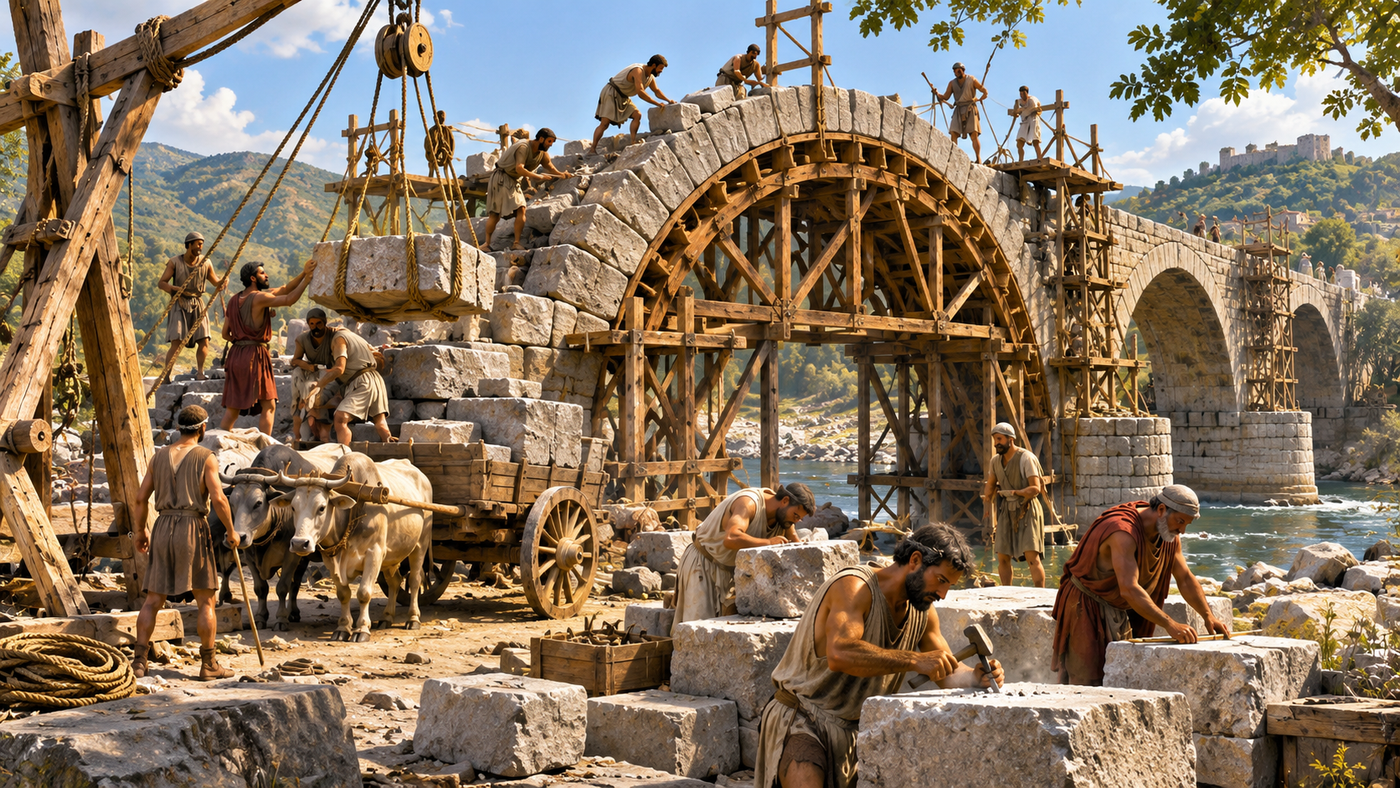
Constructing a bridge centuries ago required careful planning and extensive manual labor.
Builders relied on tools such as ropes, wooden scaffolding, pulleys, levers, and lifting devices.
Large stone blocks were transported using carts, sledges, boats, and other methods suited to local conditions.
For arch bridges, temporary wooden frameworks called centering supported the stones during construction.
Once the arch was completed and became structurally stable, workers could remove the temporary supports.
Accurate measurements were essential because incorrectly positioned stones could compromise the structure.
Ancient builders developed practical knowledge through observation, experimentation, and experience passed between generations.
Their achievements demonstrate that sophisticated engineering does not necessarily depend on modern electronic technology.
The Importance of Strong Foundations
A bridge’s durability depends not only on the structure visible above the ground but also on the foundations supporting it.
Ancient engineers understood that unstable foundations could cause serious structural problems.
When constructing bridges across rivers, builders needed to account for water currents, sediment movement, and seasonal changes in water levels.
Some used temporary barriers or cofferdams to create working areas for foundation construction.
Others selected locations where solid rock or stable ground could support heavy masonry structures.
Bridge piers were sometimes shaped to reduce resistance against flowing water and limit the accumulation of debris.
These design decisions helped improve structural stability and reduce damage caused by river conditions.
Modern engineers continue to consider many of the same environmental factors when designing bridges.
Historic Bridges Across Different Cultures

Bridge construction developed independently across many regions of the world.
In China, the Zhaozhou Bridge, constructed during the Sui dynasty, is an outstanding example of early stone arch engineering.
Its distinctive open-spandrel design reduces structural weight while maintaining strength.
In Europe, medieval stone bridges became important transportation links connecting towns, markets, and agricultural regions.
Some included buildings, shops, and defensive structures.
In mountainous regions, communities developed suspension bridges using natural fibers and other locally available materials.
These structures demonstrate how different societies adapted engineering methods to their environments.
Although construction materials and techniques varied, the underlying goal remained the same: creating safe and reliable connections across difficult terrain.
Why Some Ancient Bridges Have Lasted So Long
The survival of historic bridges reflects several important factors.
Durable construction materials, appropriate structural designs, and stable foundations contribute to long-term performance.
Stone bridges can resist weathering when suitable materials are selected and properly maintained.
Arch structures are particularly effective at distributing loads through compression.
However, survival also depends on environmental conditions and continued maintenance.
Flooding, earthquakes, erosion, and changes in surrounding landscapes can damage even well-designed bridges.
Many historic structures have survived because communities repaired and reinforced them over time.
Their longevity therefore reflects both the achievements of original builders and the preservation efforts of later generations.
What Modern Engineers Can Learn From Ancient Bridges
Modern bridge engineering uses advanced materials, mathematical modeling, and computer-assisted design.
Nevertheless, ancient bridges remain valuable subjects of study.
Their construction demonstrates the importance of understanding structural forces, material properties, and environmental conditions.
Traditional masonry techniques can also provide insights into sustainable construction and the conservation of historic infrastructure.
Engineers studying ancient bridges examine how loads move through arches, how foundations interact with surrounding ground, and how structures respond to long-term environmental exposure.
These investigations can help improve restoration methods and preserve important architectural heritage.
Preserving Historic Bridges for Future Generations
Historic bridges are more than transportation structures.
They represent cultural achievements, technological development, and the history of communities connected by trade and travel.
Preservation requires careful inspection, appropriate maintenance, and sensitivity to original construction methods.
Modern restoration projects often combine traditional craftsmanship with advanced engineering analysis.
Protecting these structures allows future generations to appreciate the skills and knowledge of ancient builders.
Ultimately, the engineering secrets behind ancient bridges reveal a remarkable story of human creativity and practical problem-solving.
Their survival demonstrates how thoughtful design, suitable materials, and careful construction can produce structures that remain useful and admired long after their original builders are gone.
As modern infrastructure continues to develop, ancient bridges provide enduring examples of how engineering can connect communities across both geographical distances and historical generations.
